
Why Healthy Relationships Can Feel Unsafe After Relationship Trauma
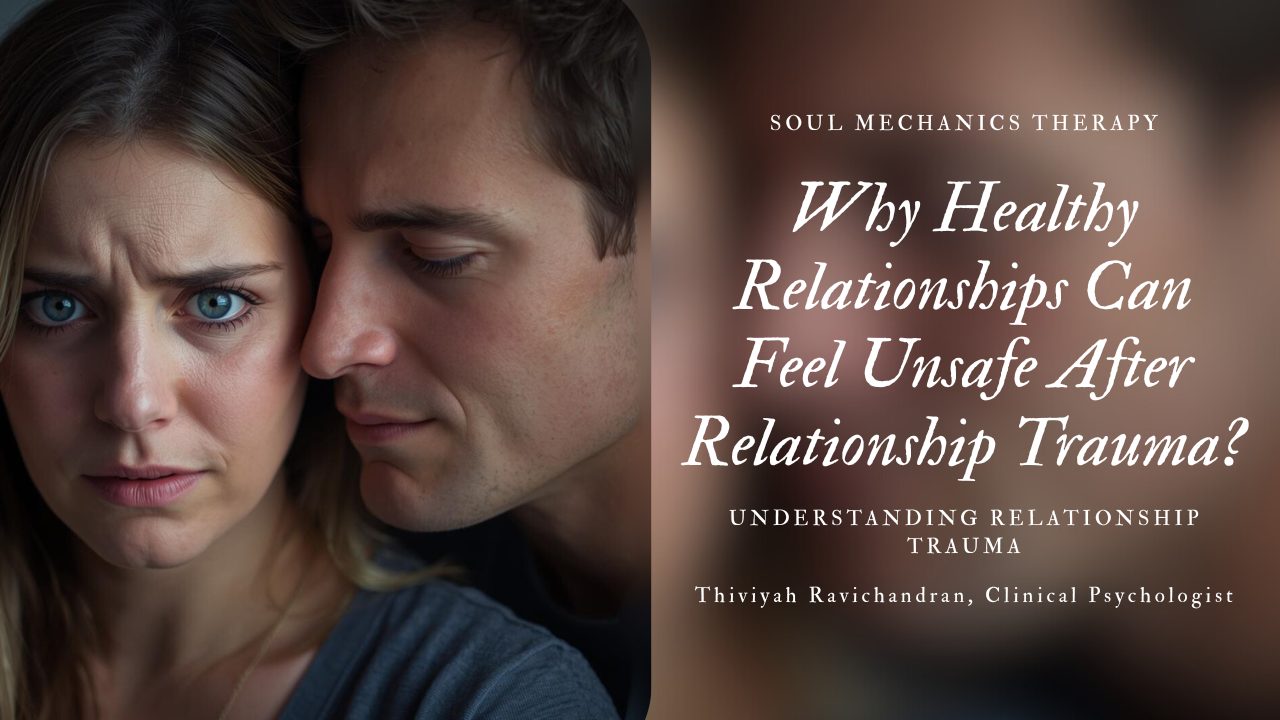
Why Healthy Relationships Can Feel Unsafe After Relationship Trauma

Written By: Thiviyah Ravichandran, Clinical Psychologist (MAHPC(CP)00620),
Feeling anxious, guarded, or emotionally on edge in a relationship that looks healthy from the outside can be deeply confusing. Lately, many individuals and couples in Malaysia including Kuala Lumpur, Petaling Jaya, and Ipoh share this experience, even when their partner is patient, kind, and consistent.
When nothing is “wrong,” yet your body stays alert, it often points to relationship trauma rather than a problem with your current relationship. This trauma forms when past emotional experiences taught your nervous system that closeness was unpredictable, unsafe, or painful.
This is not emotional weakness. It is your body responding to what it once needed to survive.
What Is Relationship Trauma?
Relationship trauma develops when people or relationships that were meant to feel safe instead became inconsistent, emotionally unsafe, or unpredictable.
It can come from experiences such as:
- Emotional neglect during childhood
- Affection that appeared and disappeared without explanation
- Criticism, shaming, or emotional invalidation
- Controlling or manipulative partners
- Caregivers whose moods shifted suddenly
- Love that felt conditional rather than secure
Not all trauma is dramatic or visible. Often, it looks like:
- Walking on eggshells
- Becoming smaller to avoid conflict
- Learning not to need support
- Carrying emotional weight alone
Over time, your nervous system adapts by staying alert. It learns:
“Connection can hurt. Stay prepared.”
Why Healthy Relationships Can Trigger Anxiety
When you enter a healthy relationship after emotional chaos, your mind may understand that you are safe, but your body may not yet agree.
This internal conflict is common in people healing from relationship trauma.
Calm Can Feel Unfamiliar
If love once came with emotional highs and lows, withdrawal, or instability, calm may feel strange rather than soothing.
Calm is not boring.
Calm is the absence of fear.
Your nervous system simply hasn’t lived there long enough to recognize it as safe.
Relationship Trauma in the Malaysian Context
In Malaysia, emotional struggles within relationships are often minimized or misunderstood. Many people grow up learning to:
- Stay quiet to keep family harmony
- Endure emotional discomfort rather than express needs
- Prioritize responsibility over emotional safety
- Avoid “burdening” others with feelings
In cities like Kuala Lumpur, Petaling Jaya, and Ipoh, high work stress, long commutes, and cultural expectations around endurance can further reinforce emotional suppression. Over time, this can condition the nervous system to associate closeness with pressure rather than safety.
As a result, even healthy relationships may trigger anxiety not because something is wrong, but because emotional safety was never modelled consistently.
Your Body Learned to Stay Alert to Survive
You may have learned to:
- Monitor moods to stay safe
- Stay quiet to prevent conflict
- Care for others instead of being cared for
These strategies once protected you. But in healthy relationships, they can show up as anxiety, overthinking, or emotional distance.
This is not resistance to love.
It is protection shaped by experience.
Expressing Needs Once Felt Risky
If your emotions were ignored, minimized, or used against you in the past, vulnerability can now feel unsafe.
You may notice:
- Holding back feelings
- Apologizing for needing reassurance
- Worrying that you are “too much”
Remember this, you are not difficult.
You are unlearning survival strategies.
How Relationship Trauma Shows Up Day-to-Day
Relationship trauma doesn’t always look like conflict. It often appears quietly through patterns such as:
- Pulling away when closeness increases
- Replaying conversations for hidden meaning
- Interpreting neutral behaviour as rejection
- Feeling tense during peaceful moments
- Expecting emotional withdrawal after intimacy
There may be an inner voice saying:
- “Don’t get attached.”
- “They’ll eventually leave.”
- “This won’t last.”
These are not character flaws.
They are learned protective responses.
You Are Not Broken, You Are Healing From a Lack of Safety
Many people respond to this experience with self-blame:
- “I should be able to trust.”
- “Why can’t I relax?”
- “What’s wrong with me?”
Nothing is wrong with you.
You did not become afraid of love.
You became afraid of pain inside love.
Your nervous system guarded you when safety wasn’t available. Now, it needs time to relearn what safety feels like.
That is not weakness.
It is adaptation and healing.
In clinical settings across Kuala Lumpur, Petaling Jaya, and Ipoh, therapists often see individuals who intellectually understand that their partner is safe, yet still struggle with anxiety, hypervigilance, or emotional withdrawal. This disconnect between the mind and body is a common outcome of unresolved relationship trauma and it is treatable with the right therapeutic support.
How Healing From Relationship Trauma Begins
Healing is not about forcing trust or pushing discomfort away. It’s about slowly creating safety internally and relationally so your body can soften in its own time.
1.0 Notice the Body Before the Story
Instead of asking “What’s wrong with me?”, try:
- Where do I feel tension right now?
- What does this reaction remind me of?
- Does this belong to the present or the past?
2.0 Share Your Experience at a Safe Pace
You don’t need to explain everything all at once. Sometimes it sounds like:
- “When things get close, I sometimes feel scared.”
- “If I pull away, I may need reassurance not distance.”
3.0 Redefine What Safe Love Looks Like
Healthy love is:
- Consistent
- Emotionally steady
- Respectful
- Kind
- Calm
You Deserve a Love That Does Not Hurt
Feeling uneasy in a healthy relationship does not mean you are failing. It means you are healing from a time when love required self-protection.
Healing often shows up quietly:
- Staying present during comfort
- Allowing someone to care for you
- Letting your body soften one breath at a time
You are not too much.
You are not behind.
You are learning safety and that is a deeply courageous work.
Therapy Support in Kuala Lumpur, Petaling Jaya & Ipoh
If you recognize yourself in this experience, working with a trained mental health professional can help you understand how relationship trauma lives in the body and how to rebuild emotional safety without forcing trust or rushing healing.
At Soul Mechanics Therapy, our therapists work with individuals and couples across Kuala Lumpur, Petaling Jaya, and Ipoh, supporting those who feel emotionally unsafe even in healthy relationships.
Healing does not require you to relive the past.
It requires safety, consistency, and compassionate guidance.
If you would like to understand how psychological patterns shape romantic relationships, you may read our complete Relationship Psychology Guide here.
For more content related to mental health, follow us on our official Instagram.