
The Guilt of Resting: Why Doing Nothing Feels Wrong
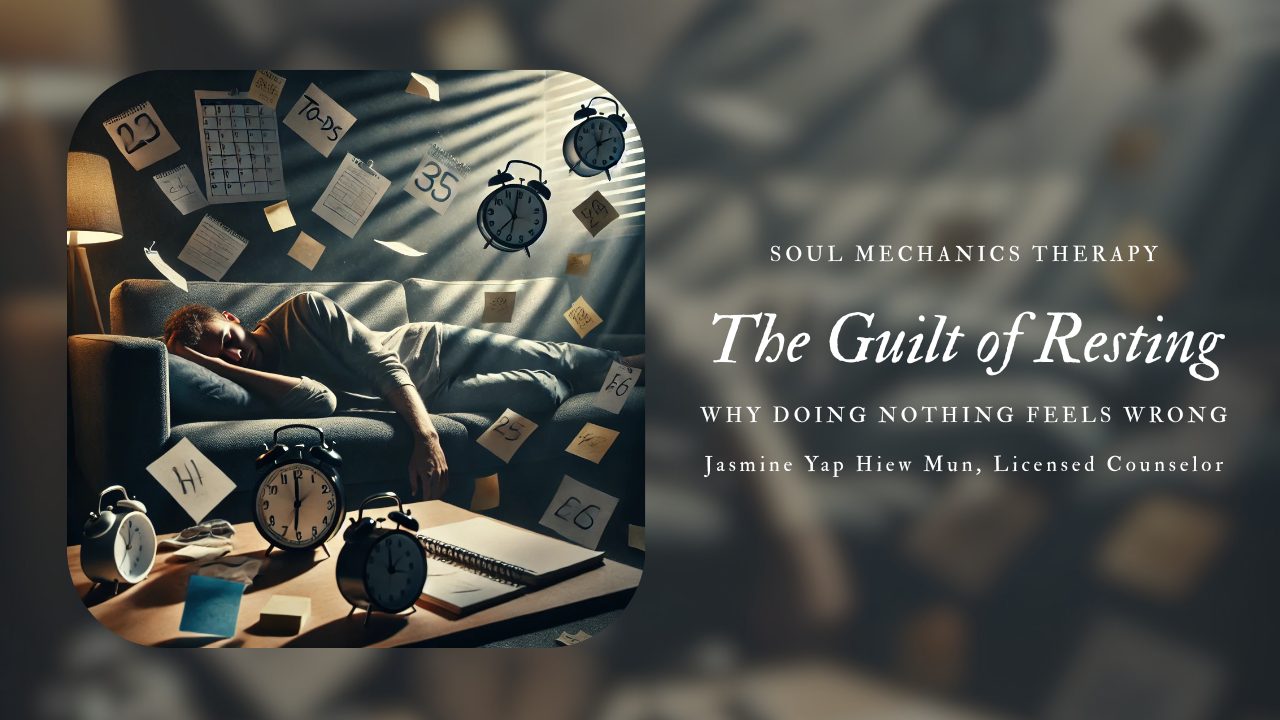
The Guilt of Resting: Why Doing Nothing Feels Wrong

Written By: Jasmine Yap Hiew Mun, Licensed Counsellor (KB12644),
The guilt of resting affects many people who feel uneasy, anxious, or ashamed when they slow down, even when their body clearly needs rest. If you have ever paused, sat still, or taken a break only to feel lazy or unproductive, you are not alone.
For many, resting triggers self-criticism rather than relief. Productivity becomes tied to self-worth, and doing nothing begins to feel like failure. Over time, this pattern can quietly exhaust both the mind and body.
In many Asian and Malaysian contexts, hard work is often praised as discipline and success. Rest, however, may be viewed as wasting time or falling behind. As a result, guilt, shame, and constant comparison often replace ease and recovery.
How the Guilt of Resting Shows Up in Daily Life
The guilt of resting does not always appear as a clear thought. Instead, it often shows up through behavior and internal pressure.
You may notice:
- Feeling anxious or restless when sitting still
- Staying busy to feel worthy or acceptable
- Filling every moment with tasks or responsibilities
- Feeling constantly tired yet unable to stop
- Harsh self-talk such as “I’m lazy” or “I should be doing more”
Over time, these patterns affect emotional wellbeing, self-esteem, and physical health often without being recognized as a rest-related issue.
Why Rest Can Feel Unsafe or Undeserved
For many people, difficulty resting develops slowly. Earlier experiences may have taught them that slowing down leads to criticism, rejection, or loss of approval.
Some grew up learning that:
- Love was earned through performance
- Mistakes were not tolerated
- Strength meant endurance, not softness
- Rest was allowed only after achievement
As a result, the nervous system learns to stay alert rather than relaxed. Even in safe moments, the body remains on guard. This is why rest can feel uncomfortable instead of soothing.
Mental health education by the Ministry of Health Malaysia also highlights how chronic stress and pressure can affect emotional regulation and long-term wellbeing.
Is Resting Actually Wrong?
Rest is not a reward for productivity.
It is a biological and emotional necessity.
When people rest, the body restores energy, the nervous system regulates itself, and clarity returns. Without rest, emotional reactivity increases, focus declines, and burnout becomes more likely.
Importantly, rest does not look the same for everyone. Some people recover through stillness, while others need movement, creativity, or quiet connection. Meaningful rest depends on what helps your system settle, not on comparison or external standards.
Organisations such as Befrienders Malaysia also acknowledge that ongoing emotional strain without relief can lead to burnout and emotional distress.
Starting to Rest Without Guilt
Learning to rest does not require dramatic lifestyle changes. Instead, it often begins with permission.
You can start by:
- Taking short breaks without justification
- Noticing physical signals of fatigue and responding earlier
- Allowing pauses between tasks
- Letting rest exist without productivity attached
Rest does not need to be earned.
Rest supports your ability to live, work, and relate with steadiness.
When Guilt About Rest Signals Something Deeper
Sometimes, the guilt of resting connects to earlier emotional patterns where worth depended on usefulness. In these cases, slowing down can bring up fear, shame, or a sense of being “not enough.”
If resting consistently triggers distress, therapy can help explore where these beliefs formed and how to gently release them. Therapy does not force rest. Instead, it helps your nervous system learn that slowing down is safe.
A Gentle Reminder
It is okay to rest.
You do not need to justify pausing.
Your value does not disappear when you stop.
Rest is not the opposite of strength.
Often, it is how strength is sustained.
When Support Can Help
If this article resonates, it may be a sign that resting has never truly felt allowed or safe for you.
At Soul Mechanics Therapy, we support individuals across Malaysia who struggle with burnout, exhaustion, and the guilt of resting. Therapy offers a calm, safe space to understand these patterns and rebuild a healthier relationship with rest.
If you are considering speaking to a therapist in the Kota Damansara or Ipoh area, you may explore our services whenever you feel ready.
You do not need to earn rest and you do not need to carry this alone.