
Relationship Anxiety: Why You Feel Insecure Even When Nothing Is Wrong
Relationship Anxiety: Why You Feel Insecure Even When Nothing Is Wrong

Written By: Thiviyah Ravichandran, Clinical Psychologist (MAHPC(CP)00620),
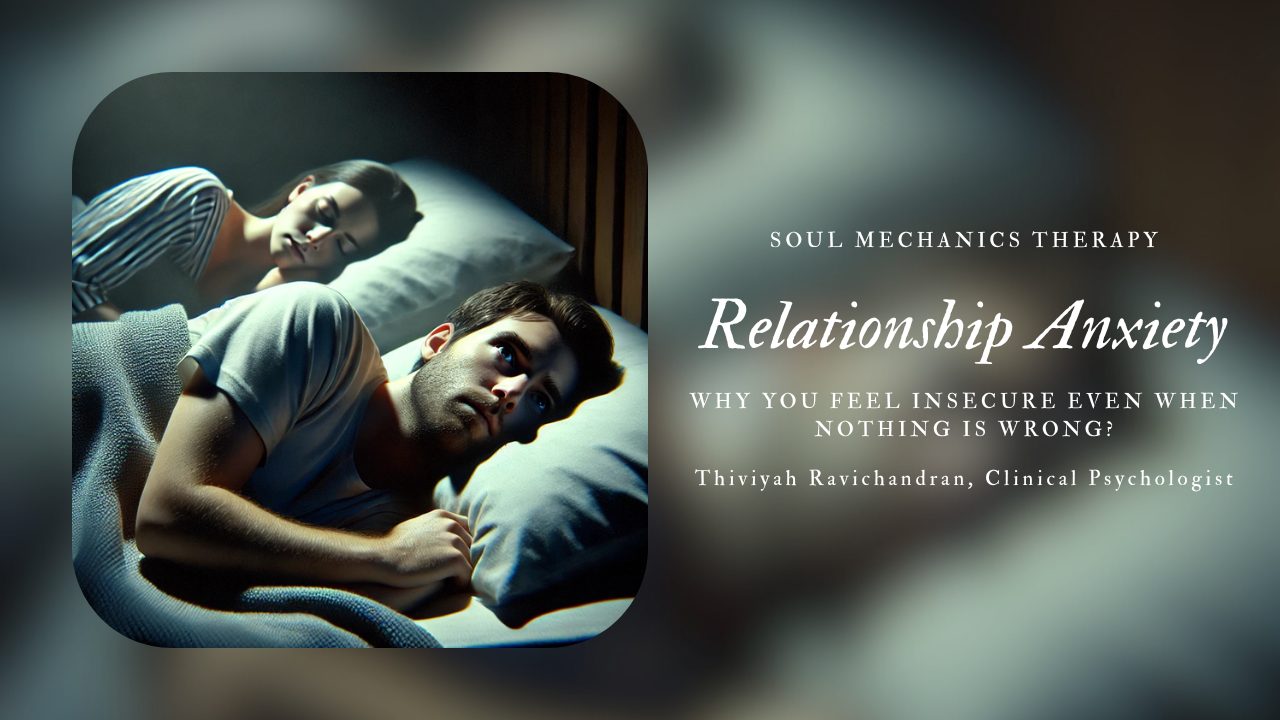
Some people enter loving, stable relationships and still feel unsettled. Nothing is actually wrong. There is no conflict, no betrayal, no sign of danger yet the mind starts to worry and the body feels tense.
You may find yourself:
- Reading between the lines of a message
- Noticing pauses in conversation and wondering what they mean
- Replaying interactions in your head, searching for something you missed
On the surface, everything looks fine.
Inside, there is doubt.
Many people describe this as confusing or frustrating. They say things like, “I know my partner cares about me, but I can’t stop feeling insecure,” or “I keep waiting for something to go wrong, even though the relationship is healthy.”
This experience is often referred to as relationship anxiety.
It is not a sign of weakness, immaturity, or emotional failure. Most of the time, it is rooted in earlier experiences where closeness felt uncertain, inconsistent, or emotionally unsafe.
The anxiety does not come from the current relationship.
It comes from the nervous system remembering what closeness once felt like.
What Relationship Anxiety Actually Is
Relationship anxiety is not the same as jealousy or simple insecurity. It is a persistent sense of uncertainty that appears even when reassurance is present and the relationship is functioning well.
It may show up as:
- A constant need to check whether your partner still cares
- Fear that the relationship could suddenly disappear
- Hyper-awareness of tone, facial expressions, response time, or small changes in behaviour
Logically, you may know nothing is wrong.
Emotionally, your body remains prepared for loss.
This response often develops in people who grew up in environments where love and emotional safety were unpredictable. Affection may have come and gone. Closeness may have felt conditional. Trust may have been broken early.
The body stores those experiences.
So when a healthy relationship appears later in life, the nervous system may still expect instability even when the present is stable.
What Relationship Anxiety Feels Like From the Inside
Many people with relationship anxiety describe a quiet internal cycle.
A small shift happens, a shorter reply, a distracted conversation, a longer pause between messages. The mind begins to analyze. Meaning is assigned. Scenarios appear. The body tightens, even if nothing significant actually occurred.
Some people respond by seeking reassurance or closeness.
Others withdraw because vulnerability feels unsafe.
Some alternate between the two.
The anxiety is rarely loud.
It often lives beneath the surface.
It can sound like:
- “What if they stop loving me?”
- “What if I’m too much?”
- “What if they leave and I didn’t see it coming?”
This is not drama or exaggeration.
It is fear shaped by past experiences of uncertainty in relationships.
Where Relationship Anxiety Often Begins
Relationship anxiety frequently traces back to earlier attachment experiences not always dramatic or overtly traumatic ones.
Sometimes it comes from:
- Growing up needing to earn approval
- Experiencing emotional distance or inconsistency
- Learning to stay quiet to avoid conflict
- Being comforted sometimes, but not always
A child who had to perform to receive affection may grow into an adult who feels insecure even when loved. A person who experienced emotional abandonment may learn to anticipate loss before it happens.
The nervous system adapts.
It learns to stay alert not because the present requires it, but because the past once did.
How Relationship Anxiety Affects Healthy Relationships
Relationship anxiety can quietly shape behaviour in ways that others may not immediately understand.
You may:
- Need reassurance but feel embarrassed to ask
- Overthink during moments of closeness
- Become overly accommodating to avoid upsetting your partner
- Withdraw emotionally because relying on someone feels risky
The conflict often happens internally rather than externally.
A partner may interpret these behaviors as mistrust or emotional distance, when in reality, they are protective responses attempting to avoid the pain of potential loss.
The anxiety is rarely about the partner.
It is about what connection has meant before.
Understanding Relationship Anxiety Without Blaming Yourself
Healing begins by recognizing that relationship anxiety is not a character flaw. It is a nervous system response shaped over time.
Instead of asking, “Why am I like this?”
It can be more helpful to ask:
- When did closeness first feel uncertain?
- Which experiences taught me to expect disconnection?
- What part of me is still trying to protect itself?
This shift allows compassion to replace self-criticism.
In therapy, these questions are explored gently, not to relive pain, but to understand how deeply the body learned to stay guarded.
How Healing Begins in Relationships
Relationship anxiety does not disappear through positive thinking or forcing trust. Healing happens through consistent experiences of safety, at a pace the nervous system can tolerate.
Communicating your experience can be part of this process. Sharing that you sometimes feel anxious or need reassurance does not make you needy, it allows connection to become more honest and grounded.
A supportive partner does not need to fix the anxiety.
Their role is to respond with steadiness and patience.
Over time, the nervous system begins to learn:
- Love can exist without instability
- Closeness does not always lead to loss
- Connection can remain even when fear arises
This learning is slow and relational, built moment by moment.
Reclaiming Safety Within Yourself
Healing relationship anxiety also involves reconnecting with your own sense of worth.
Many people carry quiet beliefs such as:
- “I am replaceable.”
- “I must be perfect to be loved.”
Therapeutic work gently challenges these beliefs through self-compassion, emotional grounding, and deeper awareness of one’s own needs.
As internal safety strengthens, love becomes less about fear and more about presence, choice, and emotional honesty.
You no longer relate from anxiety.
You begin to relate from stability.
Therapy Support in Kuala Lumpur, Petaling Jaya & Ipoh
If you feel insecure in a relationship even when nothing is wrong, you are not broken. You are responding from a nervous system shaped by earlier experiences of uncertainty.
At Soul Mechanics Therapy, we support individuals and couples across Kuala Lumpur, Petaling Jaya, and Ipoh who struggle with relationship anxiety, attachment concerns, and emotional insecurity even in healthy relationships.
With the right support, the nervous system can learn to soften, feel safer, and allow closeness without constant fear.
This article is for educational purposes and does not replace personalized mental health care.
If you enjoyed reading this, why not learn about "Unlocking the Secrets of Betrayal: The Forbidden Truth Behind Infidelity!"? You can read the blog here. This blog aims to to educate and create awareness about infidelity in relationships.
For more content related to mental health, follow us on our official Instagram.