
Relationship Anxiety: Why You Feel Insecure Even When Nothing Is Wrong
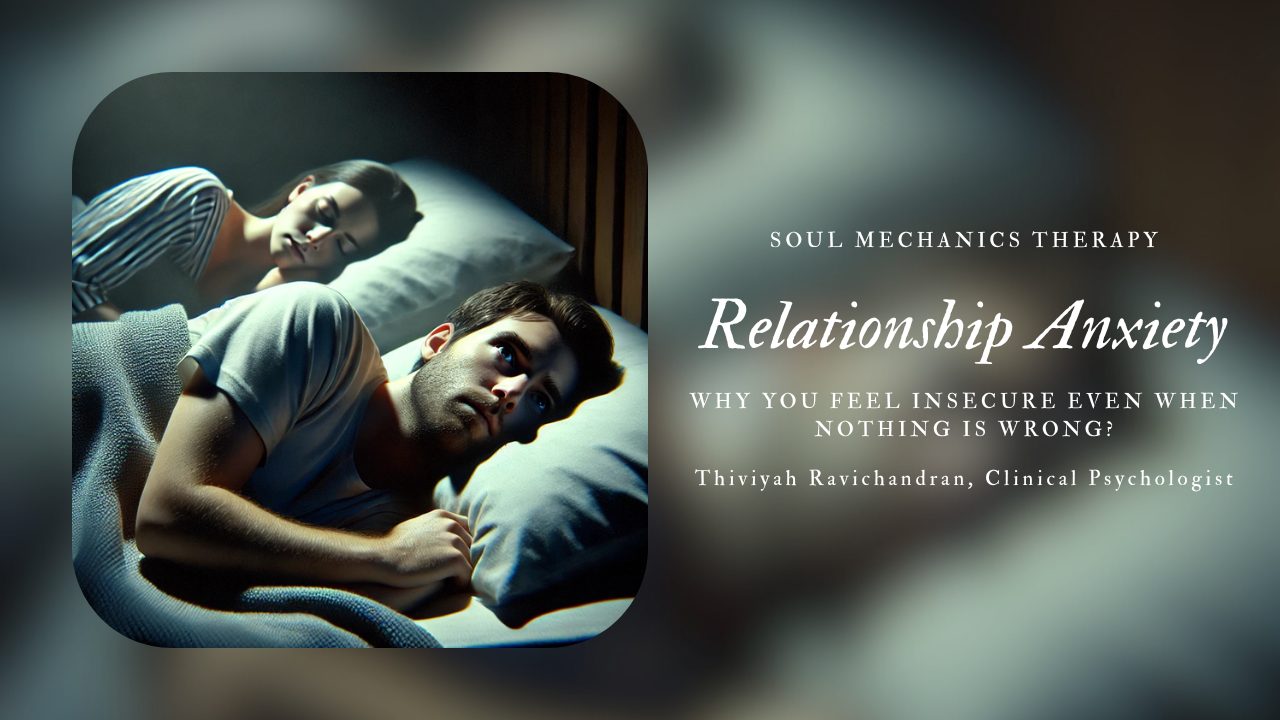
Relationship Anxiety: Why You Feel Insecure Even When Nothing Is Wrong
Many people experience relationship anxiety even when they are in loving and stable relationships. There may be no conflict, betrayal, or obvious sign that something is wrong, yet the mind begins to worry and the body feels tense.
You may notice yourself:
- Reading between the lines of a message
- Noticing pauses in conversation and wondering what they mean
- Replaying interactions in your mind, searching for something you may have missed
On the surface, everything appears fine.
Inside, there is doubt.
Many individuals describe this experience as confusing or frustrating. They may say things like:
- “I know my partner cares about me, but I still feel insecure.”
- “Nothing is wrong, but I keep waiting for something to go wrong.”
This experience is often referred to as relationship anxiety.
Relationship anxiety does not mean the relationship is unhealthy. In many cases, it reflects how the nervous system learned to respond to closeness based on earlier relational experiences.
The anxiety does not always come from the present relationship.
Sometimes, it comes from the nervous system remembering what closeness once felt like.
Quick QnA
Relationship anxiety is persistent fear or insecurity in a romantic relationship even when the relationship is stable and supportive.
What Relationship Anxiety Actually Is
Relationship anxiety refers to a persistent sense of uncertainty or fear within a romantic relationship, even when reassurance, affection, and stability are present.
People experiencing relationship anxiety may notice:
- A strong need to check whether their partner still cares
- Fear that the relationship could suddenly end
- Hyper-awareness of tone, facial expressions, or response time
- Overthinking small changes in behaviour
Logically, a person may recognise that their partner is supportive and committed.
Emotionally, however, the body may still prepare for possible loss.
Relationship anxiety often develops when earlier experiences taught the nervous system that closeness could be unpredictable. Affection may have felt conditional, reassurance inconsistent, or emotional safety uncertain.
The body stores these experiences.
When a healthy relationship appears later in life, the nervous system may still expect instability even when stability exists.
What Relationship Anxiety Feels Like Internally
Many individuals with relationship anxiety describe a quiet internal cycle.
A small shift happens.
A shorter reply.
A distracted conversation.
A longer pause between messages.
The mind begins to analyse.
Meaning is assigned.
Possible explanations appear.
The body becomes tense.
Some individuals seek reassurance or closeness.
Others withdraw emotionally because vulnerability feels risky.
Some move between both responses.
The anxiety is rarely dramatic.
Instead, it often sounds like:
- “What if they stop loving me?”
- “What if I’m too much?”
- “What if they leave and I didn’t see it coming?”
These reactions are not exaggerations or emotional weakness.
They are often emotional memories shaped by earlier experiences of uncertainty in relationships.
Where Relationship Anxiety Often Begins
Relationship anxiety is often connected to earlier attachment experiences. You may explore this further in our article on Trauma and Attachment Style: How Past Trauma Shapes Adult Relationships.
These experiences are not always dramatic or overtly traumatic.
Sometimes they involve:
- Growing up needing to earn approval
- Experiencing emotional inconsistency
- Learning to stay quiet to avoid conflict
- Receiving comfort sometimes, but not always
A child who had to perform to receive affection may grow into an adult who feels insecure even when loved.
A person who experienced emotional abandonment may learn to anticipate loss before it happens.
The nervous system adapts.
It learns to stay alert not because the present relationship requires it, but because the past once did.
How Relationship Anxiety Affects Healthy Relationships
Relationship anxiety can quietly influence behaviour in ways that partners may not immediately understand.
You may:
- Need reassurance but feel embarrassed to ask for it
- Overthink moments of closeness
- Become overly accommodating to avoid upsetting your partner
- Withdraw emotionally because relying on someone feels risky
Often, the conflict happens internally rather than externally.
A partner may interpret these behaviours as mistrust or emotional distance, when they are actually protective responses shaped by earlier experiences.
The anxiety is rarely about the partner themselves.
It is about what connection once meant.
Understanding Relationship Anxiety Without Blaming Yourself
Healing begins with recognising that relationship anxiety is not a personal flaw.
It is a nervous system response shaped over time.
Instead of asking:
“Why am I like this?”
It may be more helpful to ask:
- When did closeness first feel uncertain?
- Which experiences taught me to expect disconnection?
- What part of me is still trying to protect itself?
This shift allows compassion to replace self-criticism.
In therapy, these patterns are explored gently not to relive pain, but to understand how the body learned to stay guarded in relationships.
How Healing Relationship Anxiety Begins
Relationship anxiety rarely disappears through positive thinking alone.
Healing happens through repeated experiences of emotional safety that the nervous system can gradually trust.
This may involve:
- Communicating emotional experiences honestly
- Learning to tolerate vulnerability gradually
- Developing emotional awareness and self-compassion
- Building relationships where reassurance and steadiness exist
A supportive partner does not need to eliminate anxiety.
Instead, consistent responses help the nervous system learn something new.
Over time, the body begins to recognise:
- Closeness does not always lead to loss
- Love can exist without instability
- Connection can remain even when fear appears
This learning is gradual and relational.
Safety develops moment by moment.
Reclaiming Safety Within Yourself
Healing relationship anxiety also involves reconnecting with a sense of personal worth.
Many individuals carry internal beliefs such as:
“I am replaceable.”
“I must be perfect to be loved.”
“If I make a mistake, I will be abandoned.”
Therapeutic work gently explores these beliefs through emotional awareness, grounding practices, and self-compassion.
As internal safety strengthens, relationships begin to feel less threatening.
Connection becomes less about fear and more about presence, choice, and emotional honesty.
You no longer relate primarily from anxiety.
You begin to relate from stability.
Therapy Support in Kuala Lumpur, Petaling Jaya and Ipoh
If you feel insecure in a relationship even when nothing appears wrong, it does not mean you are broken.
You may simply be responding from a nervous system shaped by earlier experiences of uncertainty.
At Soul Mechanics Therapy, we support individuals and couples across Kuala Lumpur, Petaling Jaya, and Ipoh who struggle with relationship anxiety, attachment concerns, and emotional insecurity even within otherwise healthy relationships.
With the right support, the nervous system can gradually learn to soften and experience connection with greater stability.
This article is for educational purposes and does not replace personalized mental health care.
If you would like to understand how psychological patterns shape romantic relationships, you may read our Relationship Psychology Guide here.
You can also learn more about our therapists and the areas they specialize in by visiting our team page here.
For more content related to mental health, follow us on our official Instagram.
Meet Our Relationship Experts
Our therapists at Soul Mechanics Therapy support individuals and couples experiencing relationship concerns, attachment struggles, and emotional disconnection.

Ms Devi; Relationship and Couples Therapy
Ms Devi works extensively with couples navigating communication breakdown, emotional disconnection, and trust difficulties within relationships. Many couples seek her support when they feel stuck in repeated conflicts or patterns that seem difficult to resolve on their own.
Clients frequently describe Ms Devi as calm, attentive, and deeply supportive. In therapy sessions, she creates a safe and non-judgmental environment where both partners can openly explore their emotions and perspectives. Through her guidance, couples often gain insight into their attachment patterns, emotional triggers, and communication habits.
Her work focuses on helping partners understand each other more clearly, rebuild trust after conflict or infidelity, and develop healthier ways of communicating and supporting one another.

Ms Kelly; Relationship Anxiety and Emotional Regulation
Ms Kelly works with individuals experiencing relationship anxiety, emotional overwhelm, and attachment insecurity within romantic relationships. Many clients come to her feeling confused by their own reactions, particularly when anxiety appears even within supportive and stable partnerships.
Clients often share that Ms Kelly helps them understand how their nervous system responds to stress, emotional triggers, and past relationship experiences. Through therapy, she supports individuals in developing practical tools to regulate anxiety, process difficult emotions, and approach relationships with greater clarity and self-awareness.
Her sessions combine compassion with thoughtful guidance, helping clients feel both understood and empowered as they navigate their emotional challenges.

Ms Shaundtrya; Self-Worth and Relationship Communication
Ms Shaundtrya supports individuals who struggle with self-worth, emotional boundaries, and communication difficulties in relationships. Many clients seek her help when they feel unheard, emotionally overwhelmed, or unsure how to express their needs within relationships.
Clients often describe Ms Shaundtrya as warm, patient, and deeply empathetic. Her approach focuses on helping individuals feel genuinely seen and understood while exploring deeper emotional patterns that may influence their relationships.
Through therapy, she guides individuals in rebuilding confidence, strengthening emotional boundaries, and developing healthier communication patterns within relationships.
If you would like to better understand how attachment patterns, emotional triggers, and communication habits influence romantic relationships, you may explore our Relationship Psychology Guide here.
You can also visit our team page to learn more about the therapists at Soul Mechanics Therapy and how they support individuals and couples navigating relationship challenges.