
Family Stress Child Development: How Home Life Shapes Emotions
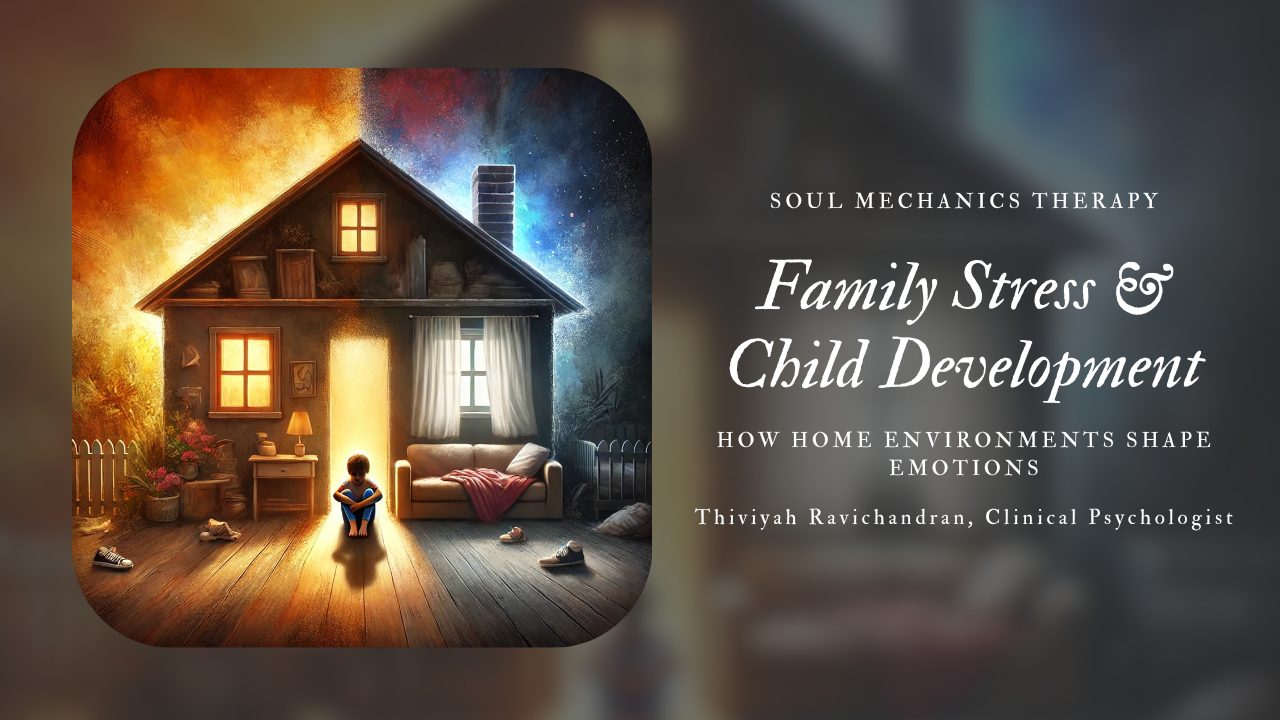
Family Stress Child Development: How Home Life Shapes Emotions

Written By: Thiviyah Ravichandran, Clinical Psychologist (MAHPC(CP)00620),
Family stress child development are closely connected, especially in homes where emotional pressure becomes part of daily life. Children do not grow in isolation. They grow inside emotional environments families, routines, and unspoken tensions that quietly shape how they understand themselves, others, and the world.
When families experience ongoing stress, children may not fully understand what is happening. However, they feel it clearly. They notice shifts in tone, emotional availability, and household energy. Even when adults try to protect them, children absorb stress through silence, conflict, or emotional distance.
Over time, family stress influences child development, shaping how children regulate emotions, express needs, feel safe in relationships, and build their internal sense of self.
Many Malaysian adults later reflect:
- “I had everything materially, but I always felt uneasy growing up.”
- “I didn’t realise how much my home environment affected me until adulthood.”
- “I learned to be strong because everyone else was struggling.”
Their emotional world was shaped not by one event, but by the atmosphere they lived in.
How Family Stress Shapes Child Development Through the Nervous System
Children experience family stress primarily through the nervous system. Unlike adults, they cannot easily explain stress in words. Instead, their bodies respond first.
When there is ongoing conflict, financial strain, marital tension, illness, grief, or emotional unpredictability, a child may remain constantly alert. They listen closely to voices, footsteps, and mood changes.
As a result, the body shifts into survival mode long before the mind understands why.
This state can affect:
- sleep and appetite
- concentration in school
- emotional regulation
- social confidence
Some children withdraw and become quiet. Others appear restless, sensitive, or reactive. These behaviours are not defiance. They are adaptations to an environment that feels uncertain.
When Parents Are Overwhelmed by Family Stress
Family stress does not mean parents lack love or care. In many Malaysian households, parents carry heavy responsibilities — work pressure, financial concerns, caregiving duties, relationship challenges, or unresolved personal stress.
When adults feel overwhelmed, emotional availability may reduce unintentionally. A child may begin to believe:
- “This is not a good time to talk.”
- “My feelings might add to the problem.”
- “I should handle things myself.”
Over time, the child learns to minimise emotional needs to protect the family system.
This is not intentional neglect. Instead, it is emotional absence shaped by stress. As adults, these children may struggle to ask for help, suppress feelings, or feel responsible for others’ wellbeing.
The “Strong” Child and Emotional Development
In families under constant stress, children often take on roles beyond their developmental stage. They comfort siblings, mediate conflict, or behave perfectly to avoid creating more tension.
They become:
- the reliable one
- the quiet one
- the child who never causes trouble
From the outside, they appear mature. Inside, they may feel unseen or overwhelmed.
They learn:
- “I must be strong.”
- “My needs come second.”
- “It’s safer not to feel too much.”
Although this adaptation is often praised, it comes at an emotional cost. Many of these children later experience burnout, over-responsibility, or difficulty receiving care in adulthood.
Long-Term Effects of Family Stress on Child Development and Emotional Safety
Growing up in a chronically stressed environment can shape child development in subtle but lasting ways. Children may struggle with:
- identifying their emotions
- expressing feelings clearly
- setting boundaries
- calming themselves during distress
- trusting emotional closeness
In adulthood, this may appear as:
- people-pleasing
- fear of disappointing others
- anxiety or overthinking
- difficulty resting
- emotional disconnection
- harsh self-criticism
These are not personality flaws. They are emotional adaptations formed early in life.
Organizations such as Befrienders Malaysia also highlight how prolonged emotional stress can affect mental wellbeing long after childhood
When Stress Becomes the Emotional Background
Short-term stress, when paired with reassurance and connection, usually does not cause lasting harm. Difficulties arise when stress becomes the emotional background of daily life.
A child who grows up in constant tension learns that unpredictability is normal. Their nervous system remains activated. Safety feels conditional.
Childhood becomes something to manage rather than fully experience.
Public mental health education by the Ministry of Health Malaysia also recognizes that unresolved emotional stress can affect long-term wellbeing
Supporting Healthy Child Development When Family Stress Is Present
Children do not need perfect homes. They need emotional presence, reassurance, and connection especially during difficult times.
Support can begin with:
- making space to talk about feelings
- acknowledging stress honestly
- reassuring the child they are not responsible
- offering comfort instead of silence
Simple statements matter:
- “You’re not alone.”
- “It’s not your job to fix this.”
- “Your feelings matter.”
Family stress may happen. Emotional isolation does not have to
A Final Reflection
If you grew up in a household where family stress shaped your emotional world, your experiences matter. You adapted in ways that helped you survive when support felt limited.
Those adaptations were intelligent even if they feel heavy now.
Healing begins when we recognise the impact of family stress on child development without blame and begin offering ourselves the emotional presence we once needed.
A child does not need perfection.
They need connection and permission for their inner world to exist.
Gentle Next Step
If this article resonates with you, whether as a parent or as an adult reflecting on your childhood you don’t have to navigate this alone.
At Soul Mechanics Therapy, we support individuals and families across Malaysia, who are affected by family stress, emotional overwhelm, and childhood patterns that continue into adulthood.
Therapy offers a calm, respectful space to explore these experiences at your own pace.
If you’re considering speaking to a therapist in Kota Damansara or Ipoh, you may explore our services whenever you feel ready.
You don’t need to have everything figured out before reaching out.