
Childhood Trauma Signs Malaysian Parents Often Miss
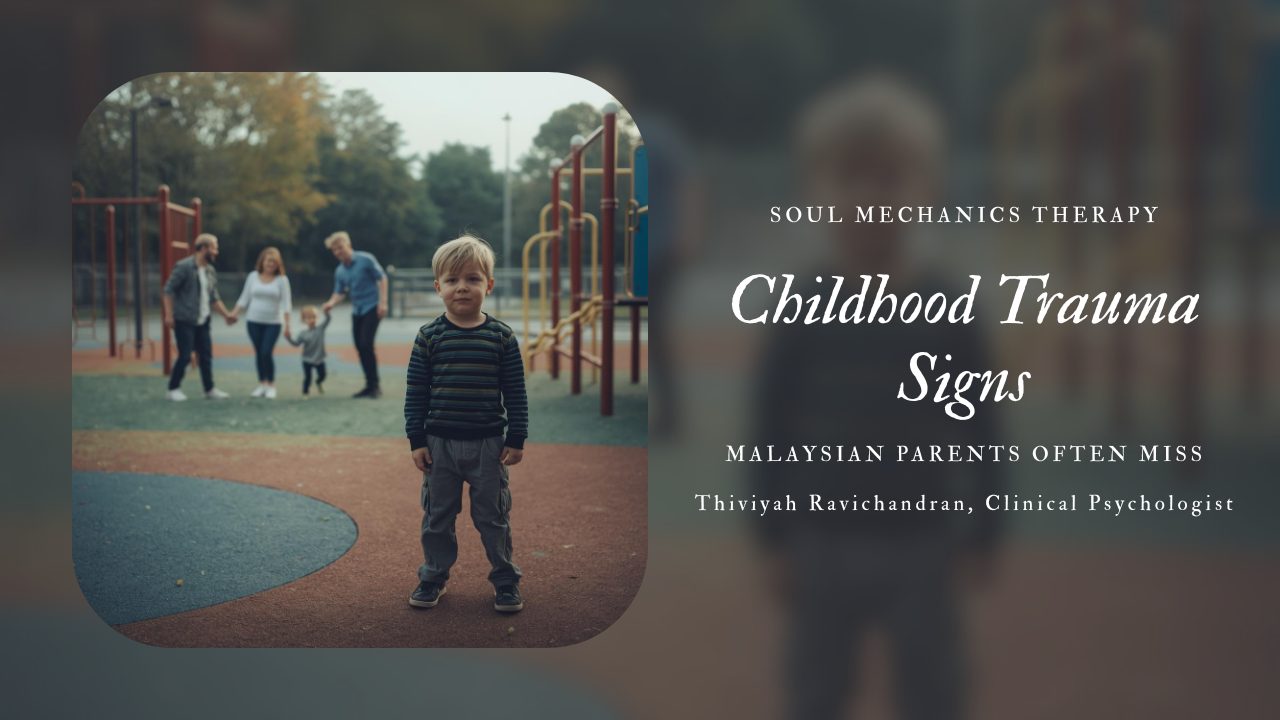
Childhood Trauma Signs Malaysian Parents Often Miss

Written By: Thiviyah Ravichandran, Clinical Psychologist (MAHPC(CP)00620),
In many Malaysian families, childhood trauma signs are often missed because children appear “well taken care of.” As long as there is food on the table, access to education, and a stable home, childhood is commonly described as normal or even good. However, childhood trauma in Malaysia does not always come from obvious abuse or neglect. Instead, it often develops quietly in emotionally rigid environments where feelings are dismissed, fear becomes normalised, or children learn to silence themselves to preserve family harmony.
Many parents work hard, sacrifice deeply, and genuinely love their children. Still, emotional experiences in childhood are not always visible on the surface. Over time, some children learn to suppress their inner world in order to keep peace within the family.
As a result, we often meet adults who grew up in stable households yet struggle with anxiety, emotional disconnection, perfectionism, or deep internal loneliness. When we gently explore their childhood experiences, they often say:
“My parents provided everything, but I didn’t feel safe to express myself.”
“I was told to be strong and not cause problems.”
“I learned to keep quiet because emotions were seen as weakness.”
Trauma is not always loud.
Instead, it often lives in what was never spoken.
Cultural Context Matters in Childhood Trauma
To understand childhood trauma signs in Malaysia, cultural context is essential. Malaysian family culture strongly values respect, obedience, emotional restraint, and social harmony. Many parents themselves grew up in survival-based environments shaped by economic hardship, migration stress, or generational beliefs such as:
- Children must behave
- Emotions should be controlled
- Adults know best
- Discipline builds character
In many cases, these beliefs do not come from malice. Rather, they arise from love, fear for the child’s future, or a deep desire to maintain stability within the family.
However, emotional experiences can still suffer even in caring households. Trauma in this context may not look like violence or abandonment. Instead, it may look like a child who slowly learns to disappear emotionally.
The “Good Child” Carrying Silent Childhood Trauma
One of the most overlooked childhood trauma signs in Malaysian homes appears in the child who never causes trouble.
The quiet one.
The obedient one.
The child who always understands.
These children rarely complain or express distress. Instead, they take responsibility early, help with family duties, and stay strong even when overwhelmed. From the outside, they appear mature and dependable.
Inside, however, they may carry:
- Fear of disappointing others
- Suppressed sadness
- Difficulty asking for help
- A belief that their needs do not matter
Over time, this child grows into an adult who equates emotional silence with strength. As a result, burnout, emotional numbness, and self-sacrifice often emerge later in life.
Not because love was absent but because emotional permission was missing.
When Discipline Creates Fear Instead of Safety
Many Malaysian parents believe discipline teaches respect and resilience. However, when discipline becomes harsh, unpredictable, or fear-based, children often internalise danger rather than structure.
As a result, fear-based upbringing may show up as:
- A child who flinches easily
- Excessive apologising
- Extreme caution around adults
- Panic when corrected
In these situations, the child is not “well-behaved.”
Instead, the child is afraid of making mistakes.
Over time, the child learns:
- Authority must not be questioned
- Mistakes feel dangerous
- Love may disappear when I fail
Later in adulthood, these early lessons often surface as anxiety, indecisiveness, or chronic self-criticism, long after the original threat no longer exists.
Emotional Invalidation as a Childhood Trauma Sign
Emotional invalidation remains one of the most common childhood trauma signs Malaysian parents unintentionally miss.
Children often hear statements such as:
- “Other people have it worse.”
- “Don’t be dramatic.”
- “Stop crying, be strong.”
- “We don’t talk about these things.”
Although the intention may be to encourage resilience, the emotional message received sounds very different:
- “My feelings are wrong.”
- “I should keep everything inside.”
As a result, children stop processing emotions and instead suppress them. Years later, this suppression may surface as:
- Emotional disconnection
- Difficulty expressing feelings
- Sudden emotional outbursts
- Depression masked by strength
They were not weak.
They simply never felt safe enough to feel.
The Child Who Grew Up Too Fast
In many Malaysian households, older children or children in struggling families take on adult roles early. They may support siblings, manage conflict, carry emotional burdens, or act as mediators between parents.
As a result, these children do not experience childhood fully, they survive it.
Later in life, they often:
- Overfunction in relationships
- Feel responsible for others’ emotions
- Struggle to receive care
- Burn out yet keep pushing forward
They receive praise for being strong.
Inside, however, they feel exhausted.
Achievement as a Hidden Trauma Response
Some childhood trauma signs hide behind academic success and high achievement. While these children receive praise, their motivation often comes from fear rather than passion. For many Malaysians, this experience overlaps with high expectations in Asian families, where success becomes tied to worth rather than wellbeing.
They may believe:
- Love must be earned
- Failure equals rejection
- Self-worth comes from success
As adults, they may:
- Feel guilty when resting
- Chase perfection endlessly
- Feel empty despite achievements
Although their struggle looks like success, emotional safety was never truly present.
How Childhood Trauma Shows Up in Malaysian Adults
Many Malaysian adults who grew up in emotionally rigid or high-pressure environments later notice:
- Difficulty trusting their feelings
- Fear of conflict or authority
- People-pleasing behaviours
- Difficulty setting boundaries
- Emotional numbness or shutdown
- A constant need to perform
They often say:
“I don’t know how to express myself.”
“I feel like I must always be strong.”
“I never learned how to feel emotionally safe.”
These patterns often connect to attachment patterns formed in childhood, which later influence how adults experience closeness, trust, and emotional safety.
These are not weaknesses.
Instead, they are survival responses formed quietly during childhood.
Organizations such as Befrienders Malaysia also recognize that unresolved emotional distress can continue affecting wellbeing long into adulthood.
Why Childhood Trauma Signs Are Often Missed
Most Malaysian parents care deeply. However, emotional health was not something many learned themselves. They learned survival, endurance, and responsibility instead.
As a result, their own childhood pain often remains unspoken. Emotional distress in their children becomes invisible, not from neglect, but from generational silence. Over time, this silence can create unacknowledged childhood grief that quietly follows a person into adulthood.
Public education by the Ministry of Health Malaysia also highlights how unresolved emotional stress can affect long-term mental wellbeing.
Because of this, understanding childhood trauma requires compassion rather than blame.
Healing Childhood Trauma Begins With Awareness
Healing does not require rejecting culture or blaming parents. Instead, it begins by acknowledging where emotional needs were unintentionally overlooked.
Therapeutic work often involves:
- Learning to recognise emotions
- Reconnecting with the inner world
- Releasing internalised fear
- Building self-compassion
- Unlearning emotional silence
For many adults, individual therapy support offers a safe and structured space to explore these patterns without blame or pressure.
For many, healing begins with one honest sentence:
“I was cared for, but I was not always emotionally seen.”
Both truths can exist together.
A Closing Reflection
If you grew up in a Malaysian household where staying quiet, staying strong, or staying invisible felt necessary, your experiences matter. Your childhood may have looked normal to others, yet still carried emotional burdens that followed you into adulthood.
You survived the world you were raised in.
Now, you are allowed to understand your story, feel what was once suppressed, and care for the child inside you who was never given space to simply be.
Healing does not erase cultural roots or family love.
Instead, it creates space for emotional truth and compassion toward both your past and yourself.
If this article resonates with you, it may be a sign that your childhood experiences are still affecting you today even if you’ve always been “the strong one.”
At Soul Mechanics Therapy, we support individuals across Malaysia, who grew up feeling emotionally unseen, unheard, or pressured to stay strong.
Therapy offers a gentle space to explore these experiences at your own pace, without blame or judgement.
If you’re considering speaking to a therapist in the Kota Damansara or Ipoh area, you may explore our services here whenever you feel ready.
You don’t need to have everything figured out before reaching out.