
ADHD or Emotional Trauma in Children?
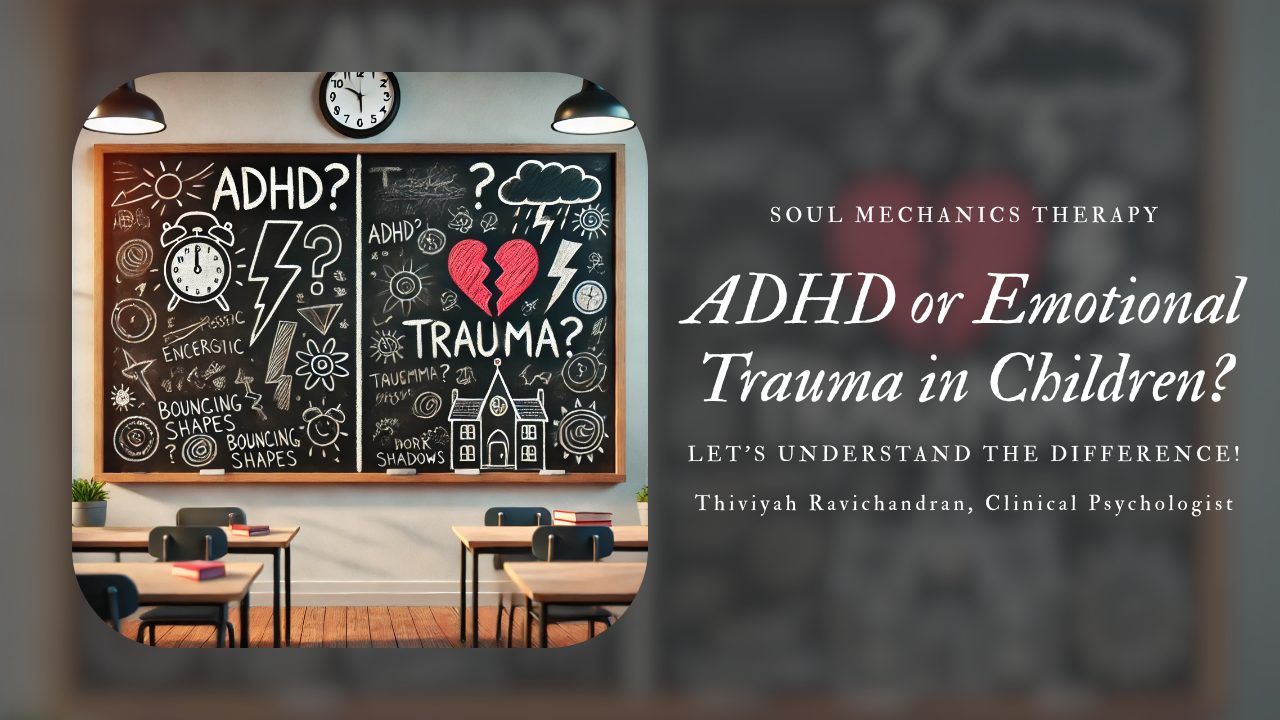
ADHD or Emotional Trauma in Children?

Written By: Thiviyah Ravichandran, Clinical Psychologist (MAHPC(CP)00620),
In Malaysia, many parents wonder whether their child’s behaviour points to ADHD or emotional trauma in children. Difficulties with focus, restlessness, impulsivity, or emotional outbursts are often quickly associated with ADHD. However, in therapeutic work, we also see children whose behaviour reflects emotional stress or unresolved trauma rather than a neurodevelopmental condition alone. Understanding the difference between ADHD or emotional trauma in children helps parents respond with clarity, compassion, and appropriate support.
When children struggle with attention or behaviour, ADHD (Attention-Deficit/Hyperactivity Disorder) is often the first explanation that comes to mind. However, in therapeutic settings, we also see another important reality. Some children who appear inattentive, reactive, or oppositional are not struggling because of ADHD alone. Instead, their behaviour reflects emotional stress or unresolved childhood trauma.
Because the signs can look similar on the surface, it can be difficult to tell the difference. Yet understanding what lies beneath the behaviour matters — not for labelling, but for supporting the child meaningfully.
Children rarely act out without reason.
Often, behaviour is how children communicate what they cannot yet say in words.
Why ADHD or Emotional Trauma in Children Can Look Similar
ADHD is a neurodevelopmental condition that affects attention, impulse control, activity level, and emotional regulation. It is linked to brain development and often appears early in childhood, across multiple settings. Mental health education from the Ministry of Health Malaysia also emphasizes that emotional stress can significantly affect children’s behavior and attention over time.
Childhood trauma, on the other hand, develops when a child experiences repeated emotional stress or a loss of safety. This may include exposure to conflict, harsh discipline, emotional neglect, bullying, family instability, frightening experiences, or feeling consistently unseen or unsupported.
Despite very different origins, ADHD and trauma can present in similar ways, such as:
- difficulty concentrating
- restlessness or fidgeting
- impulsive behaviour
- forgetfulness or disorganisation
- emotional outbursts
- sensitivity to criticism
From the outside, these behaviours may look identical.
Internally, however, the child’s experience is very different.
A child with ADHD may struggle because their brain finds regulation difficult.
A child with trauma may struggle because their nervous system remains in survival mode.
Both children need support but the type of support matters.
Signs of Emotional Trauma in Children That Mimic ADHD
Childhood trauma does not always come from extreme or dramatic events. In many Malaysian families, trauma develops quietly through chronic stress, fear, emotional invalidation, or instability that a child does not yet have the capacity to process. Organizations such as Befrienders Malaysia highlight that children experiencing emotional distress may show behavioural changes rather than verbalising their struggles.
A child affected by emotional trauma may:
- become easily startled or hyper-alert
- have trouble sleeping or relaxing
- struggle to sit still in quiet environments
- appear forgetful or frequently distracted
- “zone out” or daydream often
- react strongly to correction or perceived rejection
- seek constant reassurance or cling to caregivers
These behaviours are not signs of poor discipline or bad attitude.
They reflect a nervous system that has been working too hard for too long.
When the brain prioritizes safety; learning and attention take a back seat. What looks like inattention to adults often feels like survival to the child.
Why School Can Be Especially Overwhelming
Many trauma-affected children appear most dysregulated in school settings. In Malaysia, crowded classrooms, academic pressure, noise, strict rules, and social expectations can easily overwhelm a child who already feels unsafe internally.
For example:
- A child who cannot sit still may be releasing stored tension
- A child who interrupts may be trying not to feel invisible
- A child who avoids tasks may fear failure or shame
- A child who “shuts down” may feel emotionally overloaded
When adults misinterpret these responses, children may be labelled as lazy, naughty, or problematic. Unfortunately, punishment or shaming often increases distress rather than improving behaviour.
Instead of asking,
“What is wrong with this child?”
a more helpful question is,
“What has this child been carrying?”
When ADHD or Emotional Trauma in Children Exist Together
It is also important to recognise that ADHD and emotional trauma can exist together.
Some children with ADHD experience frequent criticism, academic struggles, or social rejection, which increases emotional stress. Likewise, children who grow up with trauma may later show symptoms that resemble ADHD.
One explanation does not cancel out the other.
Some children benefit from ADHD-specific strategies and emotional or therapeutic support. This is why assessment should never rely on behaviour alone. A child’s emotional history, family environment, and sense of safety must be part of the picture.
A diagnosis should never be a label of limitation.
It should be a doorway to understanding.
How Professionals Tell the Difference
In therapeutic and clinical work, professionals often explore questions such as:
- Did attention difficulties appear very early and across most environments?
- Do symptoms worsen during emotional stress or improve when the child feels safe?
- Is there a history of instability, fear, or relational distress?
- Does the child appear wired and impulsive, or anxious and guarded?
- Do difficulties persist even during calm, predictable periods?
ADHD tends to show consistency across settings.
Trauma-related behaviours often fluctuate depending on emotional safety.
Both experiences are real.
They simply require different approaches.
Why Compassionate Understanding Is Essential
A child living with ADHD benefits from structure, predictable routines, patience, and supportive strategies.
A child living with trauma needs emotional safety, attunement, and relational security.
Both need connection.
When children feel misunderstood, they often internalise painful beliefs such as:
- “I am difficult.”
- “I am always in trouble.”
- “Something is wrong with me.”
These beliefs can quietly follow them into adulthood.
When children feel seen and validated, regulation becomes possible.
Connection becomes the foundation for growth.
Supporting Children When ADHD or Trauma Is Unclear
If your child’s behaviour has changed or feels difficult to understand, it may help to reflect gently on:
- Have there been recent changes at home or school?
- Has your child experienced stress, loss, or conflict?
- Do they seem fearful, withdrawn, or overwhelmed?
- Do reactions intensify when they feel corrected or ignored?
- Are certain environments more triggering than others?
Seeking professional support is not about labelling your child.
It is about understanding their inner world.
A trauma-informed assessment can explore whether behaviour relates to ADHD, emotional stress, trauma responses, or a combination — and guide appropriate support.
The goal is not to “fix” a child.
It is to support them in ways that help them feel safe enough to grow.
A Closing Reflection
Children do not misbehave without reason.
Their behaviour reflects a nervous system shaped by temperament, environment, and lived experience.
Whether a child lives with ADHD, emotional trauma, or both, they deserve care that honours their experience rather than shames their struggles.
When adults slow down, stay curious, and respond with compassion, children begin to feel safe enough to regulate, learn, and heal.
And in that safety, many of the behaviours that once caused concern begin to soften.
If this article resonates with you, it may be a sign that your child’s behavior needs deeper understanding rather than quick labels.
At Soul Mechanics Therapy, we support families across Malaysia who feel unsure whether their child is experiencing ADHD, emotional trauma, or both.
Therapy offers a calm, trauma-informed space to explore what your child’s behavior may be communicating, and child-focused therapy support can help guide families through this process.
You may also find it helpful to read our article on childhood trauma signs Malaysian parents often miss.
You don’t need to have all the answers before reaching out.