
Emotional Regulation in Children
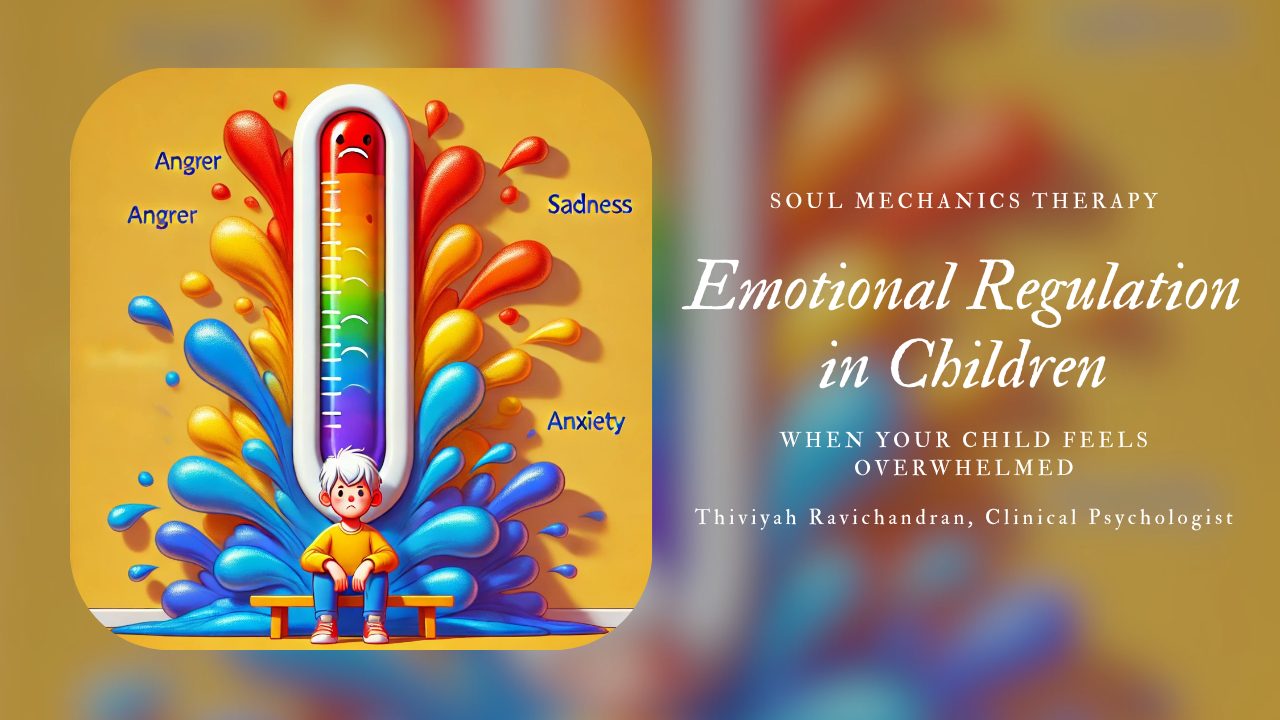
Emotional Regulation in Children

Written By: Thiviyah Ravichandran, Clinical Psychologist (MAHPC(CP)00620),
Emotional regulation in children develops long before children have the words or skills to manage big feelings on their own. What parents often see on the surface; tantrums, tears, withdrawal, irritability, sudden anger, or emotional shutdown is usually the outward expression of an overwhelmed nervous system trying to cope.
From a clinical perspective, emotional regulation in children is not about stopping strong emotions. Instead, it is about helping a child understand, tolerate, and move through feelings safely, with support rather than shame.
Many Malaysian parents feel worried or confused when their child becomes overwhelmed. They often ask:
- “Why is my child reacting so intensely?”
- “Is this behaviour normal?”
- “Am I doing something wrong as a parent?”
However, overwhelmed children are not misbehaving. They are communicating.
Behind every emotional outburst is an unmet need, sensory overload, stress response, or emotional experience that feels too big to handle alone.
Emotional regulation begins not with control, but with connection.
What It Means When a Child Is Emotionally Overwhelmed
When a child feels overwhelmed, their nervous system shifts into emotional distress. The prefrontal cortex, the part of the brain responsible for reasoning and decision-making temporarily steps back, while the emotional brain takes over.
In this state, logic, explanations, or discipline rarely help. What the child needs most is co-regulation the calm, attuned presence of a caregiver who can help their nervous system settle.
Emotional overwhelm in children may come from:
- sensory overload
- fatigue or hunger
- school pressure
- conflict at home
- social stress
- changes in routine
- internal anxiety or fear
Although the behaviour may seem sudden, stress usually builds quietly over time.
Children rarely say, “I am overwhelmed.”
Instead, they show it through their bodies.
Common Signs of Emotional Overload in Children
Children express overwhelm in different ways. Some show it outwardly, while others retreat inward.
An overwhelmed child may:
- cry easily
- become irritable or unsettled
- argue or resist instructions
- withdraw or go silent
- cling to caregivers
- refuse tasks or melt down
- act impulsively
- shut down emotionally
To adults, this may look like stubbornness or defiance.
Clinically, it reflects a stress response.
When parents shift from seeing a “behaviour problem” to recognising a “distress signal,” their responses naturally become more compassionate and effective.
What Emotional Regulation in Children Really Involves
Emotional regulation in childhood is not about forcing children to calm down quickly or suppress emotions. Instead, it involves three developmental processes:
- Recognising emotions
- Tolerating emotional discomfort
- Learning skills to soothe and recover
These abilities develop gradually and almost always through repeated experiences of being soothed by an emotionally attuned adult.
We regulate children first.
They learn to regulate themselves later.
Children build emotional capacity inside relationships, not in isolation.
How Parental Responses Shape Child Emotional Regulation
How adults respond during moments of overwhelm often becomes the child’s inner voice later in life.
When a child meets criticism, shaming, or dismissal, they may learn that emotions feel unsafe or unacceptable. In contrast, when adults respond with empathy, containment, and calm presence, children learn that emotions can be felt and eventually settled.
A regulating response might sound like:
- “I can see you’re really upset right now.”
- “That feels like a lot for you.”
- “I’m here. We’ll get through this together.”
Safety comes before coping.
When children feel safe, regulation becomes possible.
Supporting an Overwhelmed Child in the Moment
During emotional dysregulation, the goal is not problem-solving. Instead, the priority is helping the nervous system return to balance.
Clinically, we often encourage parents to:
- slow down the interaction
- lower their tone
- reduce stimulation
- stay present without overpowering
Some children regulate through physical comfort, such as gentle proximity or rhythmic movement. Others need sensory grounding, quiet space, or simple words. Some need time before talking.
There is no single correct method.
The most regulating factor is the caregiver’s calm presence.
The message the child receives is:
“You don’t have to handle this alone.”
Understanding the Child’s Emotional Story
Once the nervous system settles, the child becomes ready for reflection and learning. This is when emotional education can begin.
Parents can gently:
- help the child name feelings
- notice triggers
- reflect on body sensations
- explore what felt overwhelming
This process is not interrogation.
It builds emotional language and self-awareness.
Over time, children learn to say:
- “I felt scared.”
- “That noise overwhelmed me.”
- “I got frustrated because I didn’t understand.”
Self-awareness becomes the foundation of emotional regulation.
Patterns Malaysian Parents Often Overlook
In clinical work, we often see chronic emotional overwhelm linked to deeper patterns such as:
- long-term family stress
- high academic expectations
- frequent criticism
- school pressure
- social difficulties
- sleep disruption
- neurodevelopmental differences
- unresolved emotional experiences
Children do not simply outgrow emotional overload.
They adapt.
Some become anxious.
Others become perfectionistic.
Some disconnect emotionally.
Early support reduces long-term emotional strain. Recognising patterns reflects care, not blame. Public mental health education by the Ministry of Health Malaysia also highlights how prolonged stress and emotional overwhelm can affect a child’s emotional development over time.
The Parent’s Emotional State Matters Too
Supporting an overwhelmed child can feel exhausting. Parents may experience frustration, guilt, or helplessness, especially when their own nervous system becomes activated. Organizations such as Befrienders Malaysia also emphasise that emotional distress affects both children and caregivers, especially when support feels limited or unavailable.
Regulating a child requires the adult to feel regulated enough to do so.
Self-compassion matters.
Taking time to pause, breathe, or seek support does not mean failure. It strengthens the emotional climate children grow within.
Children benefit most when caregivers are supported, not isolated.
A Gentle Closing Reflection
When a child feels overwhelmed, their behaviour communicates more than words ever could.
They are asking:
- “Is it safe to feel this?”
- “Can I fall apart and still be held?”
- “Will someone stay with me while my emotions settle?”
Emotional regulation in children is not about eliminating big feelings.
It is about teaching children that emotions can be felt, expressed, and understood without fear of rejection.
With patience, attunement, and consistent relational support, children slowly learn that their inner world is not something to fight but something they can navigate.
And in that safety, resilience begins to grow.
If your child frequently feels overwhelmed, emotionally reactive, or shut down, you are not alone, and neither is your child.
At Soul Mechanics Therapy, we support parents and children across Malaysia, who are navigating emotional regulation difficulties, overwhelm, and stress-related behaviors.
Therapy offers a calm, respectful space to understand your child’s emotional world and strengthen regulation skills together.
If you’re considering speaking to a child therapist in Kota Damansara or Ipoh, you may explore our services whenever you feel ready.
You don’t need to have all the answers before reaching out.