
Unhealed Childhood Trauma in Adults: Signs, Emotional Patterns, and Healing
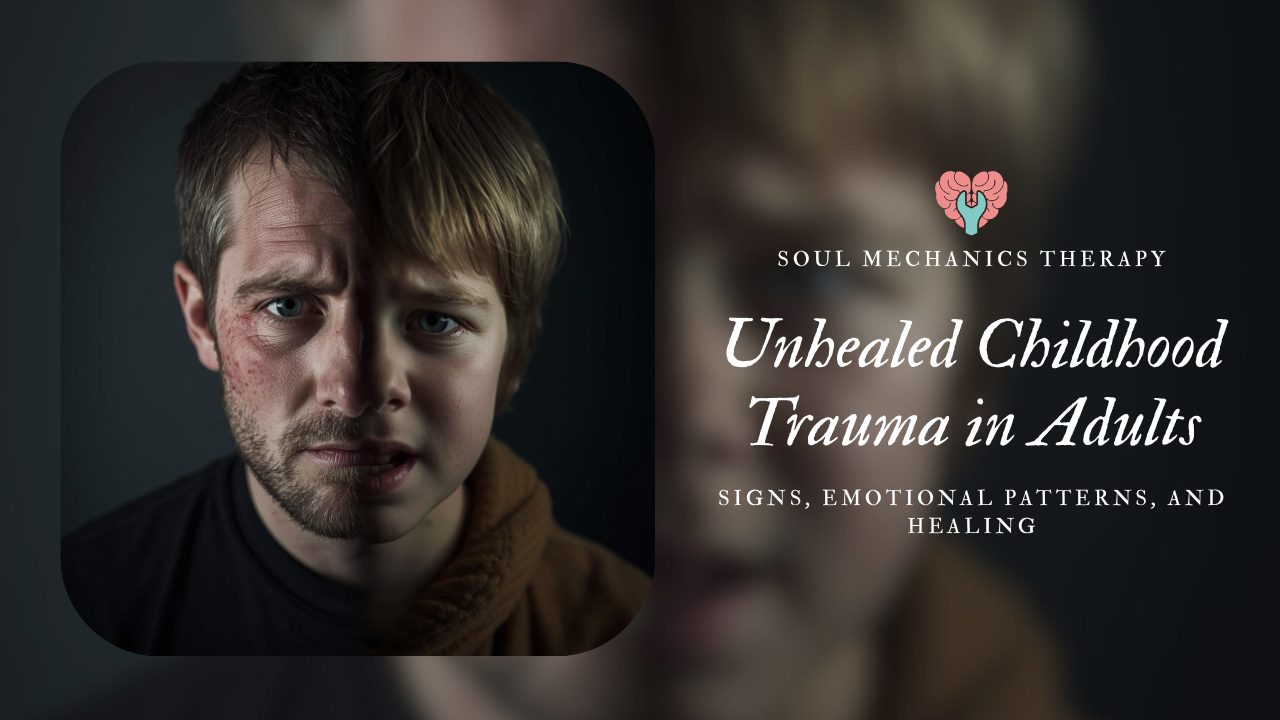
Unhealed Childhood Trauma in Adults: Signs, Emotional Patterns, and Healing
There are moments in adulthood that feel strangely familiar.
A raised voice triggers a wave of fear.
A small disagreement feels like rejection.
Silence from someone you love feels heavier than it should.
You may wonder:
“Why does this affect me so deeply?”
Often, the answer does not lie in the present.
It lies in experiences that shaped the nervous system long before adulthood began.
Unhealed childhood trauma does not always appear as dramatic memories.
More often, it lives quietly, shaping emotional reactions, relationship patterns, and internal beliefs about safety, worth, and connection.
Understanding how childhood trauma influences adult emotional life is not about blaming the past.
It is about recognising the invisible forces that continue to shape the present. You may explore how emotional patterns shape romantic relationships in our Relationship Psychology Guide.
How Unhealed Childhood Trauma Shapes the Adult Mind
Emotional Neglect and Inconsistent Caregiving
When a child grows up feeling unseen or emotionally unsupported, they may learn that their inner world is unsafe to share.
As adults, this may appear as:
- Difficulty expressing emotional needs
- Fear of vulnerability
- Discomfort receiving care or reassurance
The body learns early whether connection feels safe.
If safety was uncertain, the nervous system may continue searching for threat long after danger has passed.
Chronic Criticism and Shame-Based Environments
Children raised in environments where mistakes were met with harsh criticism often develop an internal voice that mirrors those experiences.
This inner critic may later influence:
- Self-esteem
- Decision-making
- Fear of failure
- Emotional self-judgment
Over time, external criticism becomes internal identity.
Parentification and Early Emotional Responsibility
Some children are placed in roles they were never meant to hold.
They become:
- The mediator in family conflict
- The emotional caretaker for adults
- The “strong one” who cannot show weakness
In adulthood, this strength may mask deep exhaustion.
Many struggle to receive support because their identity was built on giving it.
Growing Up in Unpredictable Environments
When emotional or physical safety was inconsistent, the nervous system adapted through hyper-alertness.
This survival adaptation may later appear as:
- Anxiety
- Hypervigilance
- Difficulty relaxing
- A persistent sense that something could go wrong
The past does not simply disappear.
It becomes a pattern the body remembers.
Emotional Patterns: How Unhealed Childhood Trauma Appears in Daily Life
People-Pleasing and Fear of Rejection
Approval may become synonymous with safety.
Many trauma survivors prioritise others’ needs to avoid conflict or abandonment.
Boundaries feel dangerous.
Self-expression feels risky.
Difficulty Regulating Emotions
Seemingly small triggers can create overwhelming emotional responses. In adult relationships, this may also appear as relationship anxiety, even when nothing is wrong.
This is not weakness.
It is the nervous system responding to emotional echoes from earlier experiences. Research in trauma psychology supports this connection.
Avoidance of Emotional Intimacy
For some individuals, closeness feels unsafe.
They may:
- Keep emotional distance
- Avoid vulnerability
- Withdraw during conflict
Protection becomes the priority, even when connection is desired.
Hyper-Independence and Over-Functioning
Extreme independence can be a survival strategy.
Many adults with unhealed trauma believe:
“If I rely on others, I will be hurt.”
This belief may coexist with a deep longing for connection.
Long-Term Effects of Unprocessed Childhood Trauma
Relationship Difficulties and Attachment Challenges
Unresolved trauma often shapes attachment patterns in adulthood.
This may lead to:
- Fear of abandonment
- Emotional withdrawal
- Trust difficulties
- Repeated relationship conflicts
Understanding attachment patterns is central to emotional healing. You may also explore how trauma shapes attachment patterns in adulthood in our article Trauma and Attachment Style.
Persistent Shame and Low Self-Worth
Many trauma survivors carry a quiet internal belief. These beliefs are often linked to struggles with self-worth and emotional identity:
“Something is wrong with me.”
This belief can influence:
- Career decisions
- Relationship choices
- Emotional confidence
Healing involves recognising that these beliefs were formed in survival, not truth.
Chronic Stress and Nervous System Dysregulation
Long-term survival mode can affect both mental and physical wellbeing.
Common experiences include:
- Emotional exhaustion
- Sleep difficulties
- Anxiety or burnout
- Difficulty experiencing calm
The body cannot distinguish past threat from present safety without intentional healing work.
Repetition of Familiar Emotional Patterns
Without awareness, individuals may recreate emotional environments similar to childhood experiences.
This can appear through:
- Choosing emotionally unavailable partners
- Remaining in unstable environments
- Repeating self-critical behaviours
Familiarity often feels safer than change, even when it causes pain.
Therapy Approaches That Support Healing From Childhood Trauma
Inner Child Work
Healing often begins by reconnecting with younger emotional parts that were unheard or unsupported.
This process allows individuals to:
- Develop self-compassion
- Understand emotional triggers
- Rebuild internal emotional safety
Trauma-Informed Therapy
Trauma-informed approaches focus on nervous system regulation.
Clients learn:
- Grounding strategies
- Emotional regulation skills
- Ways to recognise trauma responses
Healing becomes a physiological as well as psychological process.
Attachment-Based Therapy
Attachment-focused therapy explores how early relationships shape adult relational patterns. Attachment theory has been extensively studied in developmental psychology.
Through consistent therapeutic support, individuals can experience:
- Emotional safety
- Trust development
- Healthier relational dynamics
Expressive and Creative Therapies
Creative approaches allow emotional processing beyond verbal expression.
These may include:
- Art therapy
- Journaling
- Sandtray therapy
- Experiential emotional work
Expression often reaches emotions words cannot access.
Rewriting Internal Narratives
Many individuals carry deeply ingrained beliefs such as:
- “I am not enough.”
- “I am too much.”
Therapy helps gently reshape these narratives through emotional understanding and self-compassion.
Healing From Childhood Trauma Is Possible
Unhealed childhood trauma does not determine the future.
With awareness, supportive relationships, and professional guidance, emotional patterns can change.
Healing is not about erasing the past.
It is about understanding how the past shaped the present — and creating new emotional experiences that allow growth.
Therapy Support for Childhood Trauma in Malaysia
At Soul Mechanics Therapy, we support individuals across Kuala Lumpur, Petaling Jaya, and Ipoh navigating:
- Childhood trauma effects
- Emotional regulation difficulties
- Attachment concerns
- Relationship challenges
- Anxiety and stress patterns
Professional therapy provides a structured and compassionate environment to explore emotional experiences safely.
Seeking support is not weakness.
It is an intentional step toward emotional clarity, resilience, and long-term wellbeing. You may explore our therapists and their areas of expertise on our Therapist Team Page.