
Toxic Positivity: Why You Feel Pressure to Always Be Happy
Toxic Positivity: Why You Feel Pressure to Always Be Happy
“I don’t cry. I should always be laughing.”
“I’m the happy energy in my group. I must stay strong.”
“There’s no reason to be sad. Happiness fixes everything.”
If these thoughts feel familiar, you may be experiencing pressure to always be happy.
In modern life, positivity is praised. People celebrate the one who lifts the mood, motivates others, and keeps the energy high. However, when happiness becomes a role rather than an emotion, it can quietly turn into emotional exhaustion.
Many individuals do not realise that constant positivity can become a psychological survival strategy.
Understanding this pattern is the first step toward emotional balance and healthier self-awareness.
You may explore this further in our Relationship Psychology Guide.
Why Do Some People Feel Pressure to Always Be Happy?
The need to appear constantly positive rarely develops randomly.
Instead, it often forms through emotional adaptation.
Happiness as a Coping Strategy
For some individuals, staying positive helps them feel safe.
If negative emotions once led to conflict, rejection, or instability, the nervous system may learn to associate happiness with emotional survival.
Over time, positivity becomes protection.
People-Pleasing and Emotional Responsibility
Some people learn early that maintaining harmony ensures safety.
They may feel responsible for others’ emotional states.
As adults, this can lead to:
- Supressing personal distress
- Prioritizing personal distress
- Feeling guilty when expressing sadness
This emotional pattern often connects to attachment experiences and early relational environments.
Hyper-Independence and Fear of Vulnerability
Constant happiness can also signal emotional self-reliance.
By appearing strong and unaffected, individuals avoid asking for support.
This emotional pattern is also explored in our article Who Are You When You Are Alone?
This belief may sound like:
“I must handle everything alone.”
“If I show pain, I will be seen as weak.”
While independence can be adaptive, emotional isolation often increases long-term stress.
Emotional Health Is Not One Colour
Imagine your emotional world as a room filled with balloons.
If only yellow balloons representing happiness are allowed inside, the room may appear bright but feel artificial.
Real emotional health includes:
- Sadness
- Anger
- Uncertainty
- Calmness
- Joy
Psychologically, emotional flexibility supports resilience.
Suppressing emotions may reduce immediate discomfort but often increases long-term emotional tension.
Research in emotional regulation shows that acknowledging feelings helps the nervous system process stress more effectively (American Psychological Assocation).
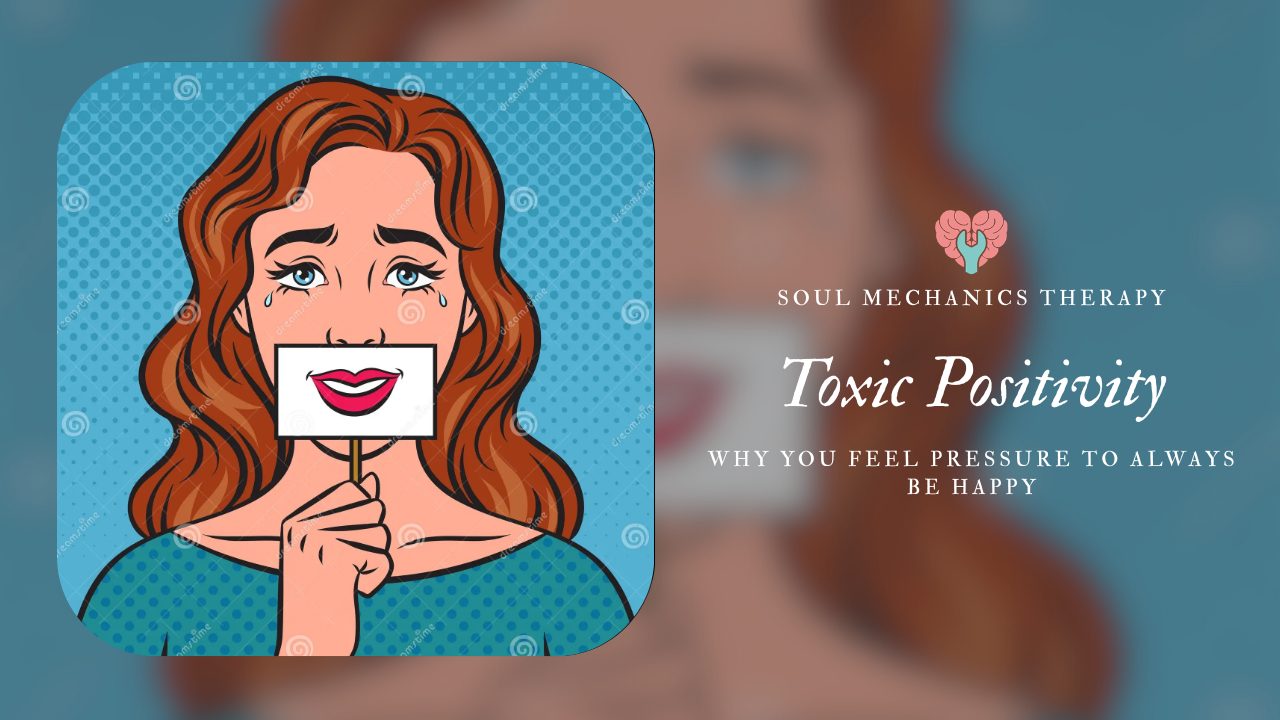
The Hidden Cost of Wearing a “Happy Mask”
For many individuals, constant positivity masks unprocessed emotional pain.
Smiling becomes a shield.
However, emotional suppression does not eliminate distress.
Instead, it may lead to:
- Emotional burnout
- Anxiety or chronic stress
- Difficulty forming authentic relationships
- Loss of self-identity
Over time, maintaining a positive facade can feel exhausting because it requires continuous emotional performance.
Therapeutically, this pattern is sometimes associated with toxic positivity (Psychology Today), where negative emotions are dismissed or avoided.
Healing From the Pressure to Always Be Happy
Emotional wellbeing involves expanding emotional awareness rather than forcing positivity.
Understand Emotions Instead of Suppressing Them
It is often more helpful to explore the reasons behind sadness than to replace it with artificial optimism.
Understanding emotional triggers supports long-term psychological resilience.
Recognise That Worth Is Not Based on Emotional Performance
You do not need to be constantly cheerful to deserve care or connection.
Emotional authenticity strengthens relationships more than emotional perfection. Developing self-compassion is often part of this process. You may read It’s Time to Hug Yourself to understand how.
Allow Yourself to Share Emotional Struggles
Expressing vulnerability does not make you a burden.
It creates opportunities for genuine connection and emotional support.
Even small statements such as:
“I feel tired today.”
“I am struggling right now.”
can help reduce emotional isolation.
Therapy Support for Emotional Suppression in Malaysia
If you feel pressure to always be happy, therapy can help you:
- understand emotional patterns
- regulate difficult feelings
- explore attachment experiences
- build emotional authenticity
- develop healthier coping strategies
At Soul Mechanics Therapy, our therapists support individuals across Kuala Lumpur, Petaling Jaya, and Ipoh experiencing:
- emotional suppression
- anxiety and burnout
- relationship difficulties
- identity confusion
- stress and emotional exhaustion
Therapy provides a safe space to experience the full range of human emotions without judgement.
You do not need to perform happiness to be worthy of support. You may also learn more about our therapists here.
Meet Our Emotional Health Experts
Ms Devi – Relationship Dynamics & Emotional Patterns
Ms Devi supports individuals who feel emotionally overwhelmed within relationships. Her work focuses on helping clients understand how emotional roles, communication patterns, and attachment experiences influence their wellbeing.
Clients often describe her sessions as grounding and insightful, helping them move from emotional performance to authentic connection.
Ms Kelly – Emotional Regulation & Relationship Anxiety
Ms Kelly works with individuals who struggle with overthinking, emotional suppression, and anxiety within relationships. Her approach integrates psychological insight with practical emotional regulation tools.
Clients frequently report gaining clarity about their emotional triggers and developing healthier coping strategies.
Ms Shaundtrya – Self-Worth & Emotional Healing
Ms Shaundtrya helps individuals reconnect with their inner emotional world, especially when they feel unseen or emotionally disconnected. Her therapeutic style focuses on rebuilding self-worth and emotional safety.
Many clients share that her work helps them feel more emotionally understood and confident.
Ms Thiviyah – Anxiety, Emotional Regulation & Inner Growth
Ms Thiviyah supports individuals navigating emotional stress, mood difficulties, and life transitions. Her integrative therapeutic approach combines cognitive, relational, and mindfulness-based techniques.
Clients often describe her sessions as empowering, helping them understand their emotional experiences while building practical skills for resilience.
Emotional Balance Means Being Fully Human
You do not need to be the “happy energy” all the time.
Emotional wellbeing is not about constant positivity.
It is about allowing the full spectrum of emotional experiences to exist.
When you begin to acknowledge your inner world honestly, healing becomes possible.
You are not meant to feel only one emotion.
You are meant to feel, understand, and grow.