
Choosing the Wrong Partners: Why Patterns Repeat
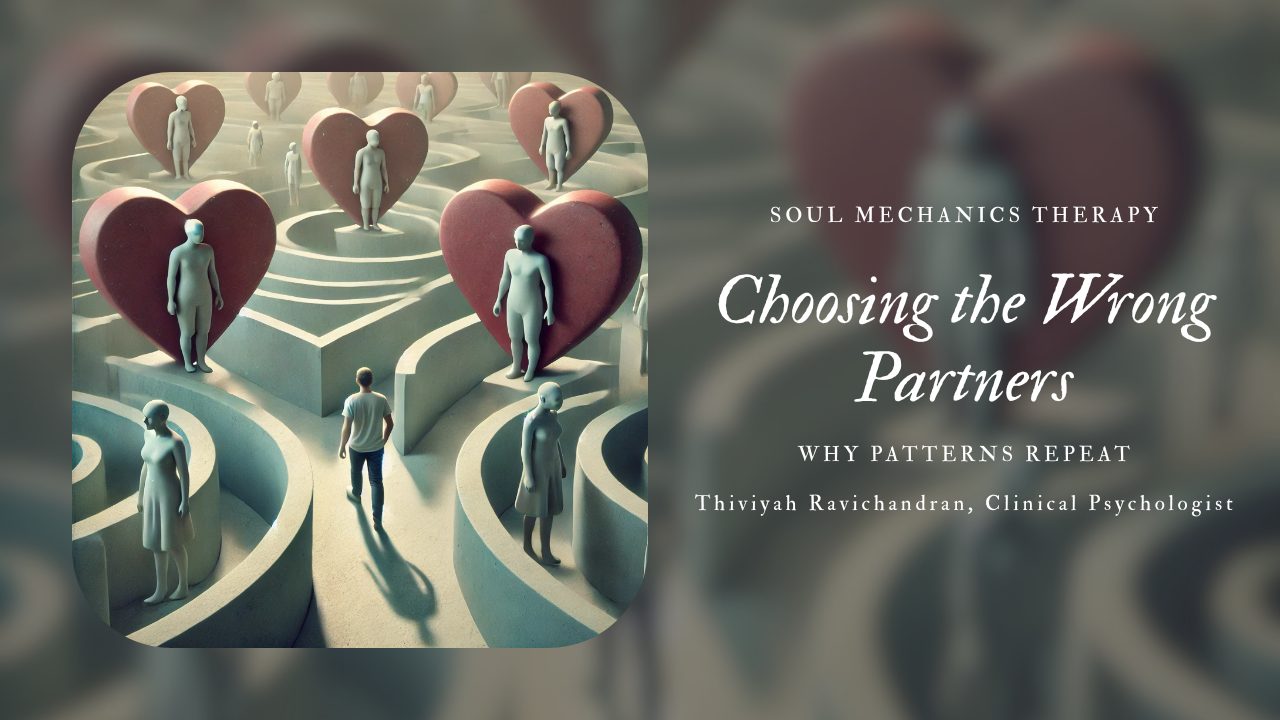
Choosing the Wrong Partners: Why Patterns Repeat

Written By: Thiviyah Ravichandran, Clinical Psychologist (MAHPC(CP)00620),
Many people eventually notice a painful pattern of choosing the wrong partners, even when they genuinely want something healthier. The faces change and circumstances shift, yet the emotional story feels strangely familiar.
They may say, “I don’t understand why I always end up in the same kind of relationship,” or “I knew something didn’t feel right, but I ignored it.” Sometimes the pattern appears subtle. Other times, it becomes painfully obvious in hindsight.
This experience does not reflect poor judgement or lack of intelligence. More often, it reflects a nervous system moving toward what it recognizes as familiar even when that familiarity is painful. People rarely choose the wrong partners consciously. Instead, unhealed relational experiences often shape attraction, comfort, and emotional expectation.
Why Choosing the Wrong Partners Feels Familiar
We often think attraction is spontaneous or chemistry-driven. However, much of it forms through early emotional learning. Our nervous system adapts to the relational environments we grow up in whether supportive, inconsistent, or emotionally distant.
For example:
- If closeness once felt unpredictable, inconsistency may later feel intense or exciting.
- If love felt conditional, emotional effort may become linked to worth.
- If affection was scarce, emotional unavailability may feel like something to earn.
The body remembers familiar emotional states. As a result, when someone recreates that environment, something inside recognises it. Not because it is healthy, but because it feels known.
In this way, familiarity disguises itself as comfort.
Attachment Patterns Behind Choosing the Wrong Partners
Attachment experiences strongly influence why people keep choosing the wrong partners. Someone who learned they had to chase love may feel drawn to partners who pull away. Someone who learned to suppress their needs may choose partners who avoid intimacy.
The pattern continues not because a person wants pain, but because the nervous system tries to resolve an unfinished emotional story.
Often, people carry a quiet hope beneath the surface:
- “This time, it will be different.”
- “This time, they will stay.”
- “This time, I will finally feel chosen.”
Instead, the cycle repeats.
The longing is real.
The pattern is unconscious.
Self-Worth and Repeating Unhealthy Partner Choices
People who repeatedly choose emotionally unavailable or dismissive partners often carry an internal belief that love must be earned rather than received.
They may:
- Tolerate disrespect
- Minimise their needs
- Overextend emotionally
- Rationalise harmful behaviour
Leaving may feel more frightening than staying.
Underneath these choices often lies a quiet narrative:
- “If I try harder, they will love me.”
- “If I am patient, they will change.”
- “If I leave, I will be alone.”
This pattern does not reflect weakness or neediness. Instead, it reflects a history of working for emotional safety. When love once required effort to secure, people easily confuse struggle with connection.
Emotional Wounds, Trauma Bonds, and Repetition
In some cases, people feel drawn to partners who reopen old emotional wounds. When a relationship mirrors earlier pain, it can create a powerful trauma bond driven by fear, longing, and unpredictability rather than genuine intimacy.
The nervous system activates. Emotional highs and lows feel intense. What feels like passion may actually be anxiety.
Calm and consistent love may feel unfamiliar or even boring by comparison.
People do not choose unhealthy relationships because they want suffering. They choose them because their nervous system has not yet learned what healthy connection feels like.
Why Red Flags Are Often Ignored
Many people later realize they noticed early warning signs dismissiveness, inconsistency, emotional detachment, or avoidance but they minimized their discomfort.
They may have:
- Hoped the partner would change
- Believed loyalty meant endurance
- Feared being seen as demanding
For some, this comes from early experiences where emotional needs were dismissed. For others, love meant tolerating discomfort.
When emotional pain is normalised early in life, red flags can feel familiar rather than alarming.
The Cycle of Choosing the Same Type of Partner
The pattern of choosing the wrong partners often repeats for three key reasons:
- The nervous system gravitates toward familiarity
- The mind tries to resolve unresolved relational wounds
- Early inconsistency or rejection shaped self-worth.
This cycle continues until awareness interrupts it. Once understood, it can be interrupted slowly, gently, and with support.
Growth does not come from forcing better choices. It comes from healing the part of you that believes painful love is all you are allowed to receive.
What Healing Looks Like
Healing begins when people change the question. Not “Why do I choose the wrong people?” but “What part of me is still searching for something I never received?”
In therapy, healing often includes:
- Learning to recognise emotional safety
- Rebuilding trust in one’s intuition
- Grieving earlier relational wounds
- Developing self-worth from within
- Understanding that love does not require self-abandonment
Healthy connection often feels unfamiliar at first. It is quieter, steadier, and emotionally consistent. It does not require chasing, fixing, or proving worth.
Instead, it invites presence rather than vigilance.
Reflection
If you find yourself repeatedly choosing partners who hurt, dismiss, or neglect you, it does not mean you are broken or incapable of change. It means your nervous system learned connection in environments where emotional safety was uncertain and those patterns have not yet healed fully.
You did not choose the wrong partners because you wanted pain.
You chose what felt familiar and what your younger self once believed was love.
With awareness, compassion, and support, people can write a different relational story. One where love is steady, mutual, and grounded in respect rather than longing.
You are not bound to repeat your past.
You are allowed to choose connection that does not require you to betray yourself.
If you enjoyed reading this, why not broaden your knowledge by learning about “High-Functioning Depression Signs: When Success Feels Empty”? You can read the blog here.
For more content related to mental health, follow us on our official Instagram.